HOBBYHELD
Case 01 · Website + live landing page
Finding a club that fits your kid
Hobbyheld helps expat parents in Germany find a children’s club nearby and book a trial without guessing.
- ROLE
- UX/UI designer, solo
- TIMELINE
- 4 weeks · solo project
- TOOLS
- Figma · Webflow
- PLATFORM
- Responsive website, desktop first
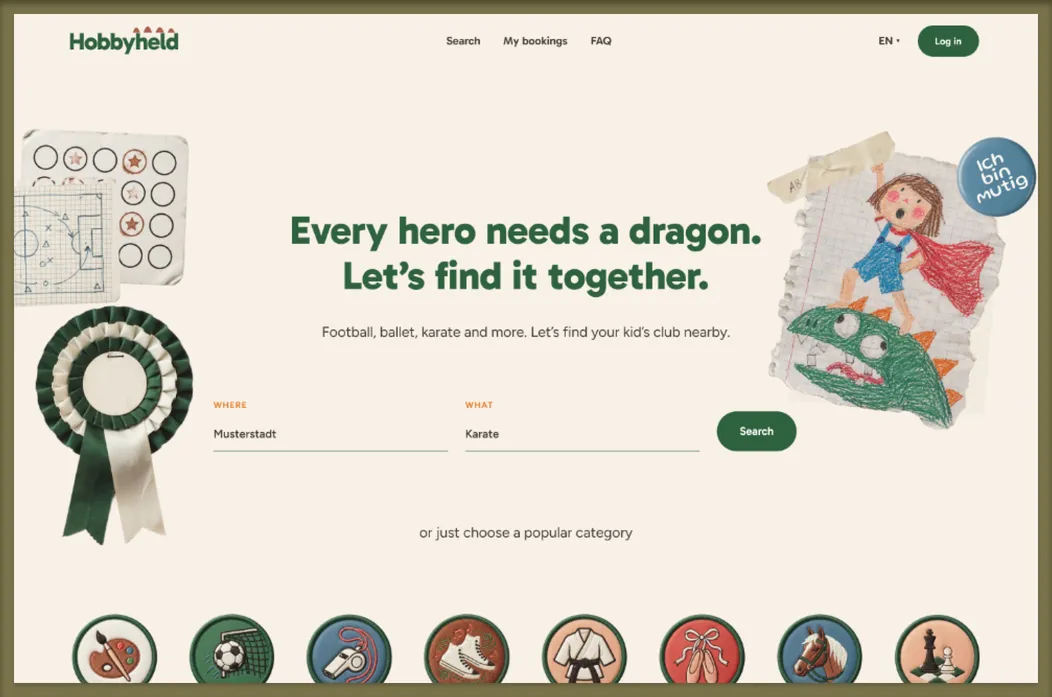
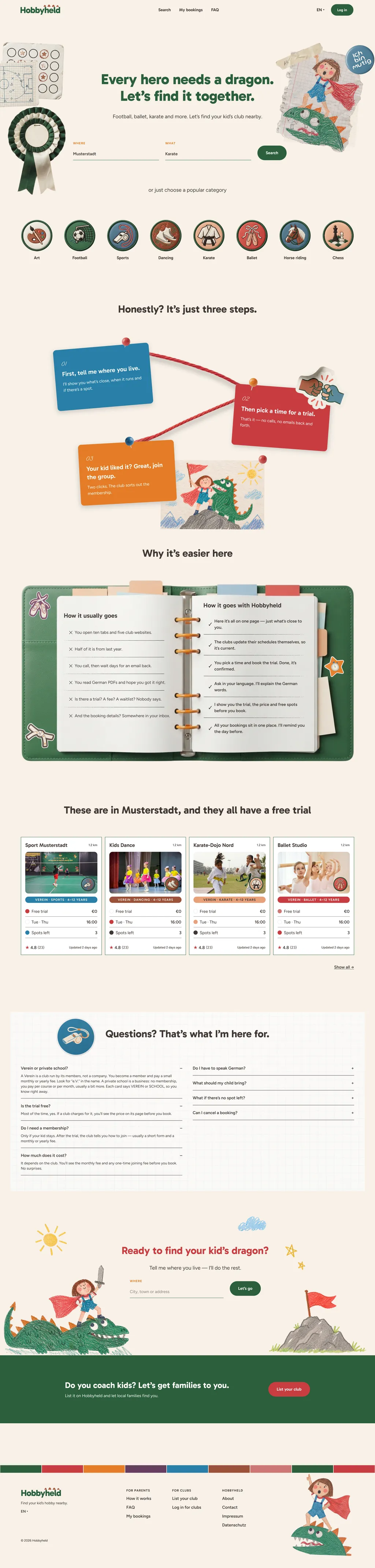
See the live landing page ↗ (opens in a new tab)Open the clickable prototype ↗ (opens in a new tab)
01 · PROBLEM
Finding a club shouldn’t feel like paperwork.
For expat parents, it often does. The real problem isn’t search, it’s trust. Club websites are outdated, prices show up only after the first class, and nobody explains how a Verein works.
3.4 / 5
how hard expat parents rated finding a club
2.1 / 5
local parents
02 · RESEARCH
Two surveys in three languages, four interviews, and a look at the competition.
20
survey answers, in Russian, German and English
4
interviews with parents
4
competitors, incl. Kindaling and ActivityHero
INSIGHT 1
“Nearby” means minutes from home, not the city.
Distance came first for 8 of 9 German parents. About 20 minutes is the limit.
INSIGHT 2
A foreign language and system make everything harder.
Expat parents rated the search 3.4 out of 5. Even 4 of 9 local parents didn’t know how trials and membership work.
INSIGHT 3
Parents don’t trust what they find.
Outdated sites in every interview, a “free” trial that cost €50, a €90 bill nobody mentioned.
HOW MY THINKING CHANGED
- Who
- “people new in town” → parents for whom the language and system are foreign
- Problem
- “no local knowledge” → they can’t trust what they find
- Goal
- “a confident choice in one evening” → the best option nearby, and the child decides at the trial
03 · KEY DECISION 1
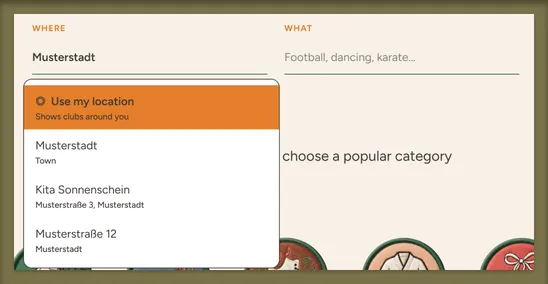
Search starts with location.
WHAT I LEARNED
For parents, distance is a filter, not a preference. If it’s more than about 20 minutes away, it’s out.
WHAT I DID
The first search field is “where”, then “what”. Distance comes first on every result card.
03 · KEY DECISION 2
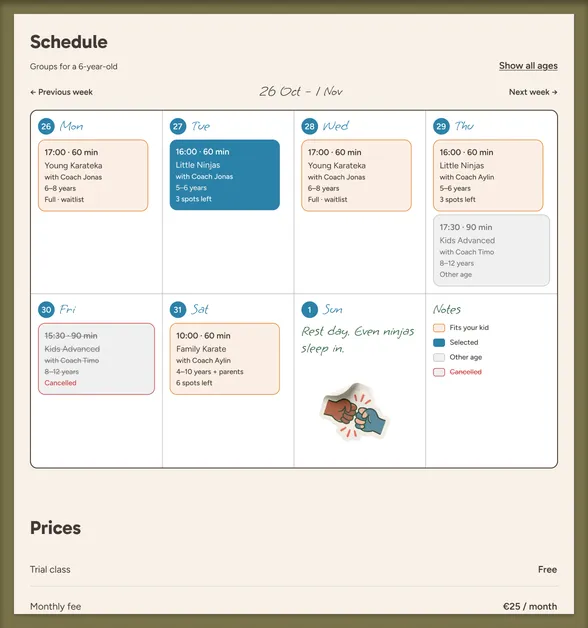
The club page follows the parent’s own checklist.
WHAT I LEARNED
One parent spent an evening reading about a club, then found out the times didn’t work for her family.
WHAT I DID
Schedule first, then the price, then how the system works, then coaches and reviews. The same order parents check a club in. Clubs keep the schedule and prices up to date themselves, and every card shows when it was last updated.
03 · KEY DECISION 3
Book the trial right on the page.
WHAT I LEARNED
For 16 of 19 parents, a trial is the norm. In the end, the child decides.
WHAT I DID
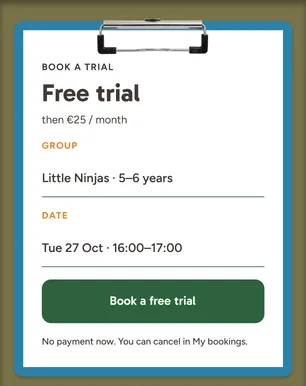
Booking takes a few clicks: pick a slot, add the child, done. Instant confirmation, no emails back and forth.
04 · VISUAL CONCEPT
A visual concept from the coach’s room.
WHAT I LEARNED
The site is for parents, but the clubs are for kids. It had to feel friendly and trustworthy at the same time.
WHAT I DID
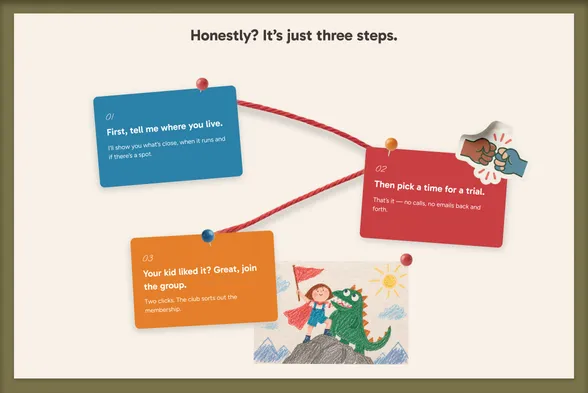
The site speaks like a coach who’s kind to kids and parents. The schedule looks drawn in a notebook, photos look like polaroids on a board, cards hang on pins.
05 · LANDING PAGE
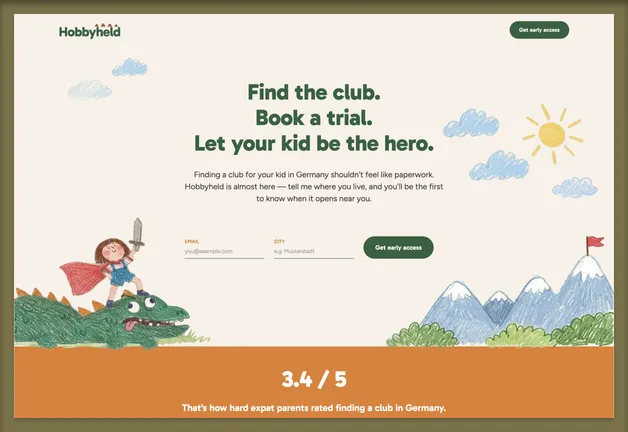
A live landing page to test the idea.
WHY
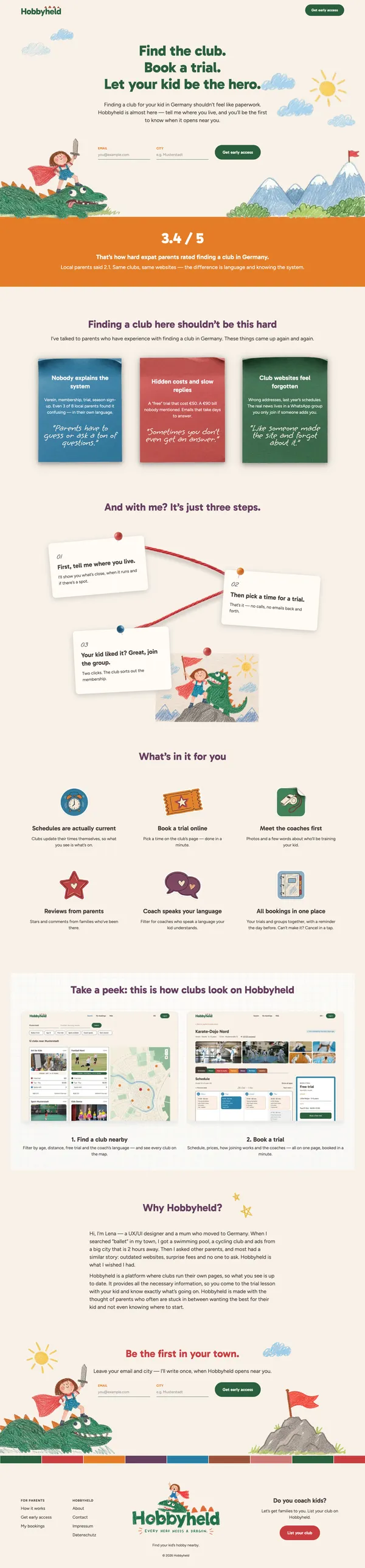
Before building the whole platform, I wanted one page that asks parents a single thing: tell me your city, and I’ll let you know when Hobbyheld opens near you. It uses real numbers and real quotes from the research.
WHAT I DID
Designed it in Figma and built it myself in Webflow, responsive for desktop, tablet and mobile. It’s live.
06 · TESTING
One early check, not a full test.
I asked my first interviewee to find a karate club nearby and book a trial.
WHAT WORKED
She booked the trial without hints, even though the prototype was in English, which isn’t her strong language. And the club page matched her own order of checking.
“Now that the schedule and the price work for me and I’ve read about the coaches, I can read about the gym. Not the other way round, where you read everything and then realise the time doesn’t fit.”
WHAT DIDN’T
Prices confused her: “Is it €25 a month or per class?” Next step: show clearly what the price covers, right on the card, and add more languages.
07 · OUTCOME
“If I had an app like this, I wouldn’t use ChatGPT to filter the information for me.”
PROUDEST OF
The club page. It answers most of the problems I heard in the interviews.
TRADE-OFFS
Desktop first: expat parents research in the evening, on a big screen. The schedule filter didn’t make the MVP, so the schedule leads the club page instead.
NEXT
Search by schedule, joining a group without a trial, messaging clubs directly.
WHAT I LEARNED
Delegating to AI without losing control. And learning the system before writing survey questions.